
First Commonwealth Kabaddi Championship in Ahmedabad: The Women's Draw Is the Real CWG 2030 Test
मुख्य उत्तर: 23 महिला मैचों का अंकगणित बताता है कि 13 देशों में से लगभग 10 ही महिला टीमें भेज रहे हैं। पहली राष्ट्रमंडल कबड्डी चैंपियनशिप की असली राष्ट्रमंडल खेल 2030 परीक्षा यही महिला ड्रॉ है। मुख्य तथ्य: • आयोजन 23-31 अक्टूबर 2026, अहमदाबाद; 9 दिन, 62 मैच — 39 पुरुष, 23 महिला। • 39 पुरुष मैच 13 टीमों के 7/6 ग्रुप और 3 नॉकआउट से मेल खाते हैं। • 23 महिला मैच 10 टीमों के 5/5 ग्रुप और 3 नॉकआउट से मेल खाते हैं। • भारतीय पुरुष कप्तान सुरजीत सिंह, उपकप्तान नवीन कुमार; महिला कप्तान निधि शर्मा, उपकप्तान रितु। • 400+ खिलाड़ियों का दावा 23 स्क्वाड के 12-खिलाड़ी अंकगणित से नहीं मिलता; स्पष्टीकरण जरूरी। स्रोत: 21 अक्टूबर 2026 को प्रकाशित मूल मीडिया रिपोर्ट; मैच-काउंट से अंकगणितीय अनुमान, आधिकारिक ग्रुप-संरचना की पुष्टि नहीं। संबंधित प्रश्नोत्तर: प्रश्न: क्या 13 देशों में सभी महिला टीमें भेज रहे हैं? उत्तर: नहीं; 23 महिला मैचों का अंकगणित लगभग 10 महिला टीमें दिखाता है, बशर्ते 5/5 ग्रुप प्रारूप हो। प्रश्न: क्या यह आयोजन राष्ट्रमंडल खेल 2030 में कबड्डी की जगह पक्का करता है? उत्तर: नहीं; यह दावेदारी का सबूत है, पर महिला ड्रॉ की गहराई अगले संस्करण में बढ़नी होगी। प्रश्न: भारत के लिए सबसे बड़ा टैक्टिकल फायदा क्या है? उत्तर: अंतरराष्ट्रीय कबड्डी फेडरेशन (IKF) के मानक नियमों से भारतीय खिलाड़ियों को अनुकूलन का दबाव नहीं होगा, जबकि कई विकासशील टीमों को होगा।
On the evening of 21 October 2026, Ahmedabad rolled out the curtain-raiser for the first Commonwealth Kabaddi Championship. The jersey, anthem, logo and mascot came out in sequence. My eyes stayed on a different number: 23. The tournament has 62 matches — 39 men's, 23 women's. The headline was the launch; the story was hiding in the match count. Twenty-three is not decoration. It is the map of the women's draw. I have checked kabaddi scorebooks since 2026, and the first numbers I look for are the ones nobody bothers to add. Three years ago, at an inter-state final, I watched a women's match get quietly moved to an earlier slot to clear the way for the men's game; the politics of the schedule starts there.
The event runs 23-31 October 2026, nine days, 13 countries, hosted by the Amateur Kabaddi Federation of India (AKFI) with International Kabaddi Federation (IKF) approval. Semifinals 30 October, finals 31 October. India's men: captain Surjeet Singh, vice-captain Naveen Kumar. India's women: captain Nidhi Sharma, vice-captain Ritu. The stated political horizon is inclusion in the 2030 Commonwealth Games programme. A 13-country first edition is an unusual size for kabaddi. Several teams are built from diaspora and development programmes, and they will not carry the sports-science staff to absorb nine days of rhythm. That inequality will show on the scoreboard.
I have watched enough kabaddi from the stands and from PKL tapes to know that the bonus line and the do-or-die raid change more tactics than most press releases admit. The IKF standard style — 30-second raid, cant, bonus line, two points for an all out — is the same family India plays. The report does not name the rule variant; IKF approval and the international field make the rectangular standard style the only coherent reading.
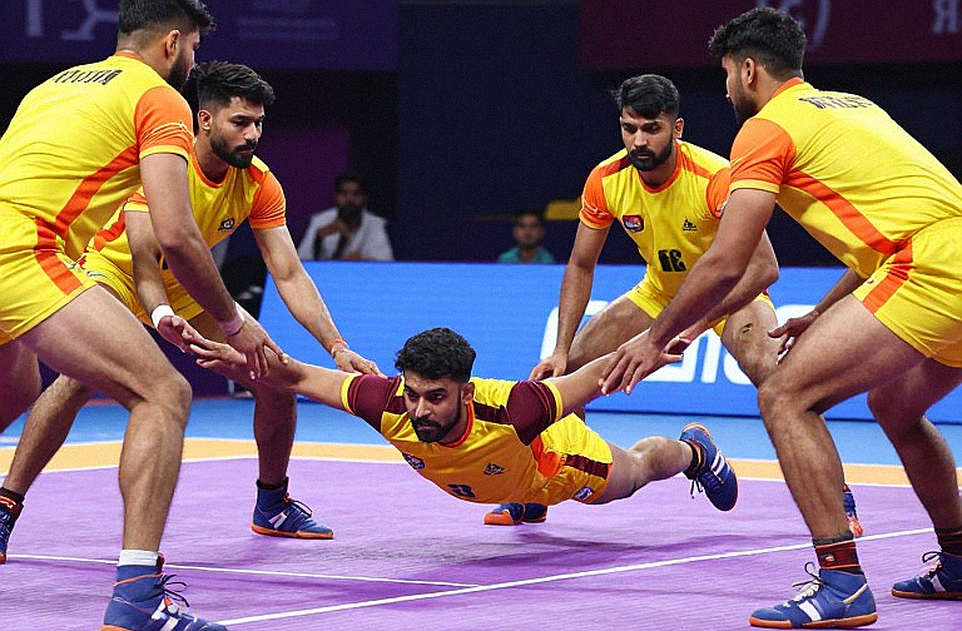
The men's 39 matches reconcile cleanly with 13 teams split 7/6: 21 + 15 = 36 group games, plus three knockouts. The women's 23 matches reconcile with 10 teams split 5/5: 10 + 10 = 20 group games, plus three knockouts. That implies roughly three of the 13 nations are not entering women's teams. The women's draw is three teams smaller than the men's; that is the biggest fact of this championship. The arithmetic is mine, not the organisers'; group compositions are not public, so the inference carries a medium-confidence tag.
Threat-first framing is a habit: the danger here is not an opponent but the three missing women's teams. Gender equity is treated as a serious criterion in multi-sport programme inclusion. A 10-team women's draw is not a failure in a first edition, but 10 out of 13 is still an incomplete map. There is a second game being played behind the scoreboard, and it usually explains the first. India's women have four Asian Games golds and no franchise league of their own; the men's PKL is a television product. The women's draw here is a portrait of that gap. The depth of the women's field does not matter only to India. If kabaddi wants a durable place in a multi-sport programme, at least eight to ten countries need a serious women's team. I started with the footnote and ended up with a better story than the headline.
Standard IKF rules lower adaptation friction for India. Indian raiders can farm the bonus line against weak tackling units, one point at a time; the margin grows without the contest growing. Do-or-die caps a weak team's ability to burn empty raids and stall. Rule uniformity does not narrow the India-field gap; it widens it. The schedule adds a physical tax: 62 matches in nine days is about seven a day, which demands multi-court operations. Squads without sports-science support carry a higher soft-tissue risk. The 400+ players claim also needs a hearing. Twenty-three squads at 12 players make 276; 400+ implies about 17 per squad. Support staff may explain it. The 400+ figure is not enough to call false, and not clean enough to use as evidence. For India, this tournament is not an adaptation test but a dominance test. Even two titles on 31 October will not erase the question of why the women's draw is three teams short.
Captaincy is the only tactical signal available, and it is thin. If Naveen Kumar is the Dabang Delhi marquee raider, India has sent a credible, PKL-calibre squad; if it is another Naveen Kumar, the signal weakens. Surjeet Singh and Ritu are common names in Indian kabaddi, with multiple bearers. Without the registered squad list, captaincy news should not be converted into tactical conclusions. The launch — jersey, anthem, logo, mascot — puts the event's centre of gravity in brand-building. The competition is subordinate.
The weakest link in my story is the group structure. The organisers have not confirmed 7/6 and 5/5. A third-place match or a different knockout shape could change the 10-team reading. The organisers can also argue that this is a first edition, that several countries have no women's league, and that travel costs are real; 10 teams and 23 matches are still a substantial start. The strongest version of that case deserves a hearing. My answer is that a bid for 2030 needs evidence, not just a beginning. The consensus was tidy, which is exactly why I went looking for the loose thread. I named the ending before the draw was made, then went back to check the receipts. I could be wrong if the organisers reconcile 23 matches with a different 12-team format; then my 10-team estimate falls. The question would change, not disappear: the number of women's teams among the 13 countries should still be public. On 21 October 2026 I am recording the bet: if the next edition has 12 or more women's teams, this was first-edition logistics; if it stays at 10, the 2030 talk is premature.
Watch the women's semifinals on 30 October and the women's final on 31 October before the men's final. If the women's medal matches are one-sided and three nations stay away, the 2030 file is thinner than the press release. If the draw is competitive and expands to 12 teams next time, the first step was in the right direction. The question is not India's winning margin. It is how many of the 13 countries can put 13 women's teams on the mat by 2030.