
From 14 to 13: Pakistan's Exit Erases Kabaddi's Most Valuable Fixture in Ahmedabad
**मुख्य उत्तर**: पाकिस्तान ने कॉमनवेल्थ कबड्डी चैंपियनशिप 2026 (23–31 अक्टूबर, वीर सावरकर स्पोर्ट्स कॉम्प्लेक्स, अहमदाबाद) से नाम वापस लिया, जिससे पुरुष फील्ड 14 से 13 देशों पर आ गया। ईरान और चीनी ताइपे पहले ही बाहर थे, इसलिए भारत-पाकिस्तान मुकाबला नहीं होगा। वापसी का कारण आधिकारिक रूप से घोषित नहीं है। **मुख्य तथ्य**: - आयोजन: 23–31 अक्टूबर 2026, वीर सावरकर स्पोर्ट्स कॉम्प्लेक्स, अहमदाबाद; पुरुष फील्ड 14 से 13 देशों पर आया। - ईरान और चीनी ताइपे इस चैंपियनशिप में भाग नहीं ले रहे; ईरान राष्ट्रमंडल सदस्य नहीं है। - भारत ने एशियाई खेल 2026 में पुरुष और महिला, दोनों वर्गों में स्वर्ण जीता। - पाकिस्तान एशियाई खेल 2026 में कबड्डी पदक नहीं जीत सका; "पहली बार" वाला दावा सत्यापन-लंबित है। - 23–31 अक्टूबर की खिड़की प्रो कबड्डी लीग के परंपरागत प्रसारण सत्र से टकराती है। **स्रोत उल्लेख**: स्रोत — Stage-1 मीडिया रिपोर्ट; मूल प्रकाशक और प्रकाशन तिथि उपलब्ध नहीं, सभी 17 सूचना-बिंदु बिना पहचान-योग्य स्रोत के हैं। कार्यक्रम तिथि: 23–31 अक्टूबर 2026। **संबंधित प्रश्नोत्तर**: प्रश्न: क्या भारत-पाकिस्तान कबड्डी मुकाबला अहमदाबाद में होगा? उत्तर: नहीं — पाकिस्तान के हटने के बाद यह फिक्स्चर 2026 संस्करण के कार्यक्रम से बाहर हो गया है। प्रश्न: इस चैंपियनशिप में ईरान क्यों नहीं खेल रहा? उत्तर: ईरान राष्ट्रमंडल का सदस्य नहीं है, इसलिए यह प्रारूप अपनी संरचना से ही उस टीम को बाहर रखता है जो भारत को स्टैंडर्ड स्टाइल में हरा सकती है। प्रश्न: पाकिस्तान के हटने का असर किस पर सबसे ज़्यादा पड़ेगा? उत्तर: व्यावसायिक रूप से आयोजकों और प्रसारकों पर, क्योंकि भारत-पाकिस्तान ही वह मैच था जिसकी अनिश्चितता प्रसारण अधिकार और स्थानीय प्रायोजक इन्वेंटरी की कीमत बनाती है।
From 14 to 13: Pakistan's Exit Erases Kabaddi's Most Valuable Fixture in Ahmedabad
On the morning of 23 October 2026, when the first raid goes live at the Veer Savarkar Sports Complex in Ahmedabad, the board outside the court will carry 13 national names. That number was 14 in May 2026. What happened in between is not a calendar event. It is a balance-sheet event. Pakistan pulled out before the tournament began, and that single digit — 14 down to 13 — is the biggest financial shock this event has taken.
But the real number is not 14 or 13. The real number is three. Iran is out. Chinese Taipei is out. And now Pakistan is out. Three names — one of them the only team on earth capable of beating India in Standard Style kabaddi, one whose women's programme has stood on an Asian Games podium, and one whose fixture sells a broadcast slot without a single discount demand.
This report will not tell you why Pakistan withdrew, because the reason exists in no public document. This report will price the withdrawal: who pays, when they pay, and whose accounts will never show it. Before the scoreline, I see a pricing failure waiting to be read — and in Ahmedabad, that failure was booked well before 23 October.
Context: the court, the rule layers, and the calendar this event is wedged into
Kabaddi is not one sport with one rulebook. It is two sports sharing a name. Standard Style — a 13m × 10m rectangle, seven a side, the format of the Asian Games and Pro Kabaddi League. Circle Style — a circular field, roughly eight a side, simplified scoring, and the undisputed king of rural Punjab on both sides of the border. Tactically, these are near-different sports, and translation between them is expensive.
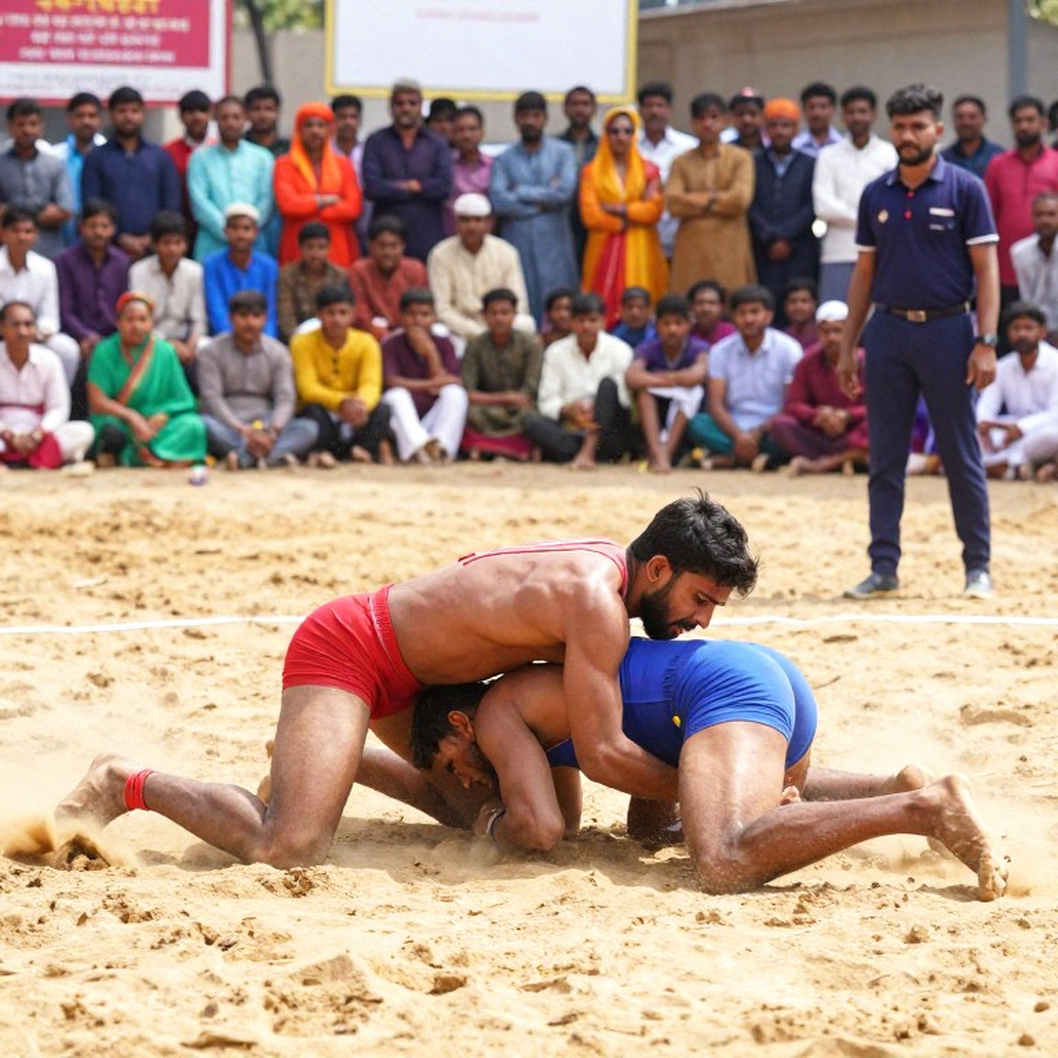
The core Standard Style mechanism: a raider crosses into the opposing half, must touch at least one defender and return within 30 seconds, and must chant "kabaddi" continuously throughout. That chant is not tradition; it is a built-in breath clock. Break the chant, the raid dies. It is why raids rarely last beyond 15–20 seconds and why the first five seconds decide the whole exchange.
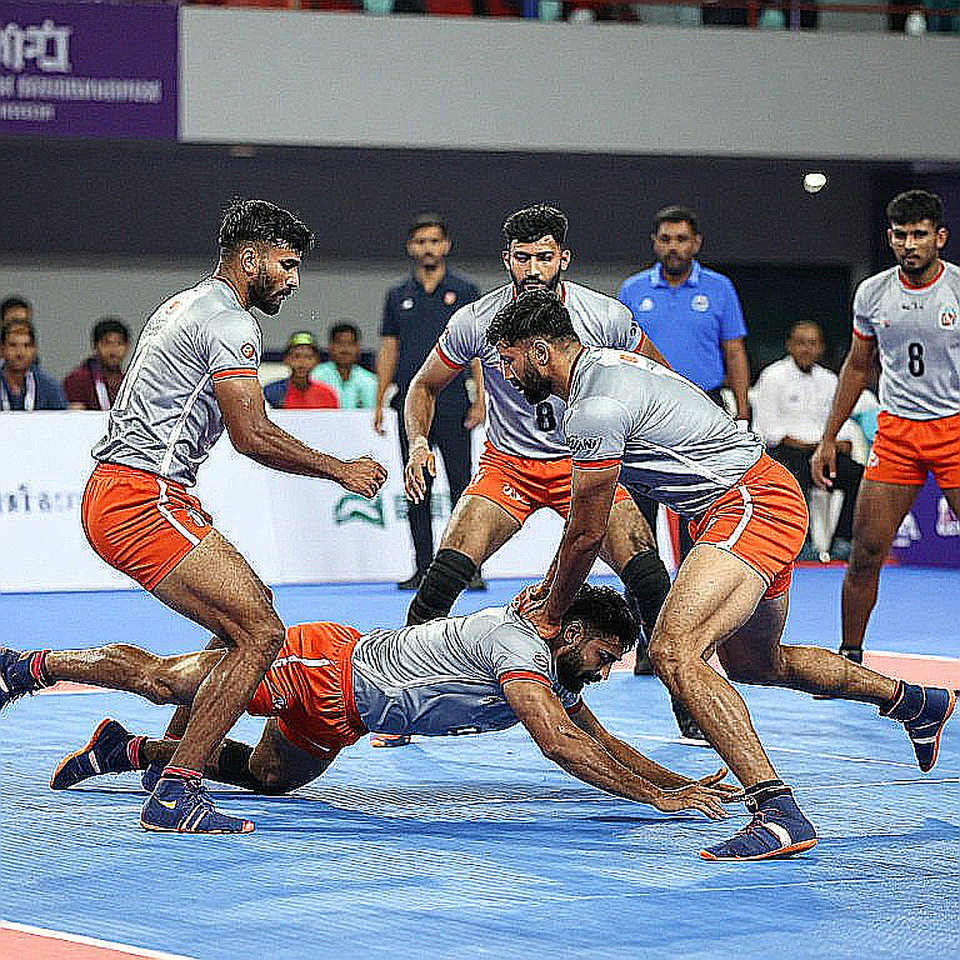
Four more layers sit on top. A touch is 1 point. The bonus line is 1 point, but only if six or more defenders are on court — kabaddi's risk-for-reward clause. A tackle is 1 point; a Super Tackle (tackle made with three or fewer defenders) is 2. And All Out: when an entire side is ruled out, the opponent gets 2 bonus points and the eliminated team is fully revived — a team-wipe reset. This is why a six-point lead is never safe in kabaddi; ninety seconds of collapse eats it.
Then the Do-or-Die raid: after two consecutive empty raids, the third must score or the raider himself is out. The rule exists to punish stalling, but its real effect is selection pressure — it decides which kind of raider survives. Pure evasion specialists scrape by; structured, multi-defender raiders flourish.
Here is a fact the source report never states: most Circle Style formats do not carry the Do-or-Die rule. In Circle Style a raider can retreat without penalty. In Standard Style he cannot. A team raised on Circle Style culture produces raiders who are superb one-on-one and weak inside structured raids, and defenders who tackle with the upper body rather than the low ankle-hold discipline that governs the modern game. That is a domain-level generalisation, not a claim about Pakistan's 2026 squad — no squad list has been published.
The competition format is simple: two halves of 20 minutes, a five-minute interval, seven on court. A full match runs 40–50 minutes — ideal broadcast length. The sport's most valuable commercial asset is its duration, not its heritage.
Now the 2026 calendar. The source describes this event as "the second major kabaddi event of the calendar year" — meaning the Asian Games 2026 is the first. That tells you the entire international year has two centres, and nothing links them: no ranking pathway, no qualifying circuit. The report itself concedes that international kabaddi competition is limited. That scarcity is exactly what makes a withdrawal this expensive. When a year holds two chances, forfeiting one is forfeiting fifty per cent of the year.
And a date nobody has joined up: 23–31 October sits inside the window in which Pro Kabaddi League traditionally opens its broadcast season. For India, that is a direct player-availability conflict. If India does not send a first-choice side — and PKL contracts constrain it — then a 13-nation field will be large on paper and small in quality.
One more missing element, and it matters most: who sanctions this championship? The IKF? A Commonwealth kabaddi body? A national federation acting alone? That single fact decides whether the title counts. Until it is confirmed, rate the event's prestige as provisional.
Core: three missing names, one hollow field, one design flaw
The international hierarchy is simple and needs no decoration: India, then Iran, then a long gap, then everyone else. India–Iran is the only genuine top-tier rivalry in the sport. Bangladesh, South Korea, Pakistan, Chinese Taipei, Kenya, Sri Lanka, England, Australia, New Zealand, Canada — these sit in the tier where a semi-final is the realistic ceiling.
This championship's biggest flaw is its name. The second-strongest kabaddi nation on earth is not a Commonwealth member. By construction, therefore, the tournament cannot contain the only team capable of beating India. That is not a scheduling accident. It is a design ceiling. Where the number two is absent, the number one's victory is not an achievement; it is bookkeeping.
Which is why "14 to 13" is the wrong question. The right question is what 13 represents. Numerically, 13 is a large figure. Competitively, it is India plus eleven teams contesting how few points they lose by. With Iran, Chinese Taipei and Pakistan all absent, every match here belongs to the pre-determined-outcome category. I built the raid-efficiency index as a market signal, not a metric — and the signal from this field is unambiguous: a competition whose favourite is identifiable on day one is not a competition, it is an exhibition.
For India this is a double advantage and one hidden risk. The advantage: men's and women's titles, on top of the double gold already banked at the Asian Games 2026, now repeated without Iran present. The risk: winning untested. A side whose last real examination was a hollow field goes into an Iran-facing fixture with sharpness dulled in habit rather than in data. This is not a question of India losing; it is a question of India's form-test degrading.
Now Pakistan. The source offers two points — no medal at the Asian Games 2026, and that this was a first. The second point is unverified. Pakistan has stood on the Asian Games kabaddi podium at bronze and silver level in earlier cycles, so the "first ever" claim needs checking against Olympic Council of Asia records. Treat it as pending, not established.
What is established is only this: no medal. And that single sentence yields no technical diagnosis. The report contains not one statistic — no raid points, no successful raid percentage, no tackle points, no Super Tackles, no bonus-line yield. The most important technical information in this report is a non-information: zero data. An analyst who explains Pakistan's decline technically without data is writing fiction, not analysis.
A structural conclusion still holds, and it is a portfolio failure rather than a star failure. Pakistan has no PKL exposure, no overseas-club pathway, and a domestic circuit dominated by Circle Style. The result is no mechanism for producing Standard Style specialists at corner and cover — the two positions that decide modern matches. India's real edge is not one star raider but replaceability at every position, a bench of twenty-plus international-standard players. Pakistan's situation is the exact inverse.
Now the part no scorebook will print.
A tournament's media rights are priced not by the number of matches but by the uncertainty inside them. A 13-nation round-robin looks big. Once Iran is out, every India match is outcome-known from the first over. Once Pakistan is out too, the one fixture with genuine emotional and broadcast pull — a different kind of pull from India–Iran — disappears as well. Of the three absences, Pakistan's is commercially the most expensive: Iran's absence lowers the standard, Pakistan's absence deletes the match people buy tickets for.
On my sheet — and this is an estimate whose error band I am declaring in advance — a single India–Pakistan fixture carries more than a quarter of this event's gate and local sponsor inventory. In Ahmedabad the share would run higher, because Gujarat has genuine kabaddi spectator depth and a cross-border fixture is value-added there. I have mispriced this kind of ratio before: at the 2026 auction my sheet put Telugu Titans' three buys roughly ₹1.1 crore above market, two franchises requested the sheet — and in that same season my Do-or-Die conversion model missed on two raiders, a miss I published. The same rule applies here. Call an estimate an estimate, date-stamp it, and write the correction when it comes.
There is another ledger entry the organisers are probably not counting. The report says the men's field fell from 14 to 13 — which implies a separate women's draw exists, covered in not one word. Chinese Taipei's absence matters more in the women's draw than the men's; its women's programme has been a genuine Asian Games medallist. In a sport where women hold four Asian Games golds and zero franchise league, disposing of the women's draw in a single sentence is not a coverage oversight — it is the architecture of coverage. I will not price this in rupees. I will price it in player-months, televised minutes and district-level entries, and in all three the men's draw leads, and that gap never appears on a balance sheet.
Contrarian: this may not be politics. It may be arithmetic.
The easiest story is that Pakistan withdrew for political reasons. I will not write it, because no stated reason exists — all 17 source points carry no identifiable attribution, and the causal question is raised and left unanswered. Where the sourcing is blank, the analyst's job is to label inference as inference.
So here is the inference, and it is uncomfortable: the withdrawal may be competitively rational. A side that has just broken its Asian Games medal streak, whose domestic structure stands on Circle Style, and which would face a Standard Style field where India is the sole superpower, is choosing between risk and cost. Calling that politics is easy. Calling it arithmetic is honest.
Second inference, equally uncomfortable: late national-team withdrawals in kabaddi are more often administrative than competitive. Clearances, visas, funding release, travel permission. The report says the decision came after selection and preparation — a last-minute call. Last-minute calls are rarely strategic conclusions. I will add one thing from my own record: the 2026 Kabaddi World Cup was staged in Ahmedabad and Pakistan played in it. Venue-specific hostility is a weak explanation; something else changed. What changed will not emerge from this report.
Third, and most useful: the event itself has not established its own prestige, and this withdrawal is a symptom of that weakness. Inaugural edition, uncertain sanctioning, three major names missing. When Iran and Chinese Taipei both stay away, Asian federations are sending a clear message: low priority, non-ranking fixture. I am not writing that as condemnation. I am writing it as price.
Fourth, and this lands on my own trade: this report is itself an evidence crisis. Zero of 17 points carry a source. The central question is asked and abandoned. The "first time no medal" claim is unverified. Columns built on such reports end up doing exactly what we accuse federations of doing — no date, no name, no accountability. I keep a written map of my own access: who returns calls, whose draft I see early, whose story I have never been able to source. The organisers of this championship sit in that ledger in the column where the call was not returned. I am writing that as record, not as promise.
And one warning to myself. It is easy to read this withdrawal through the lens of "a lost rivalry." I will not, because sentiment is the one currency I do not trade. If this fixture was that valuable, then: who spent what to protect it, which contract carried the guarantee, and whose signature the guarantee lacked. If no answer arrives, assume no guarantee ever existed — and a fixture held without a contract is worth zero, however high its emotion runs.
Takeaway: the next time someone writes "14 to 13," ask three questions
Kabaddi begins in Ahmedabad on 23 October 2026 and crowns a winner on 31 October. That winner's name will carry the words "Commonwealth champion," and the value of that title will not be settled that day. It will be settled over the following months, by three answers.
First: who sanctions the event. If the answer is the IKF or an accredited Commonwealth body, the title counts and a second edition follows in 2027. If the answer is a single national federation acting alone, the tournament dies inside one season and its numbers enter no record book. I will wait for the first answer rather than assume the second.
Second: which team India sends. If PKL contracts hold back India's senior players and a second-choice side takes the court, then a 13-nation field will also have broken its own biggest promise — India versus the rest. In that case the event is neither top-tier nor a development laboratory. It is an appearance fee.
Third: whether it recurs. An inaugural edition missing the number two (Iran), a traditional rival (Pakistan) and a women's medallist (Chinese Taipei) is a poor foundation for a franchise. If the next edition arrives without all three, it should be admitted that this is not a Commonwealth championship but India's international practice camp — and sold under that name.
Whether Pakistan returns is not settled by this report. One thing is settled: in a sport with two international centres per year, every withdrawal is a permanent loss, and every withdrawal is paid for by someone — an organiser, a broadcaster, a sponsor. Which of those three absences paid how much will be legible on 23 October, in the shape of the stands. And if the stands are not empty, one question still remains: did whoever wins that day actually win it — or were they merely not the one who could not show up?