
Commonwealth Kabaddi Championship 2026: On Ahmedabad's Day-1 Table, Fourth Place Belongs to a Team That Never Stepped on the Mat
**मूल उत्तर** कॉमनवेल्थ कबड्डी चैंपियनशिप 2026 की दिन-1 तालिका में नाइजीरिया चौथे, बांग्लादेश तीसरे और कनाडा चौथे स्थान पर हैं, क्योंकि अंक तालिका पहले जीत और फिर स्कोर अंतर से बनती है। जिन टीमों ने मैच नहीं खेला उनका स्कोर अंतर शून्य रहता है, और हारने वाली टीमें उनसे नीचे चली जाती हैं। **मुख्य तथ्य** - ग्रुप A: श्रीलंका 48-21 (+27), भारत 46-26 इंग्लैंड (+20), यूगांडा 45-29 मलेशिया (+16)। - ग्रुप B: स्कॉटलैंड 59-30 ऑस्ट्रेलिया (+29), केन्या 48-28 सिंगापुर (+20)। - स्कॉटलैंड के लवप्रीत ब्रार ने 23 रेड अंक बनाए, टीम के 59 में से कम से कम 39 प्रतिशत। - ग्रुप A में सात और ग्रुप B में छह टीमें हैं, जिससे स्कोर अंतर की तुलना असमान हो जाती है। - रिपोर्ट में क्वालिफ़िकेशन नियम, टैकल आँकड़े और भारतीय खिलाड़ियों के आँकड़े नहीं दिए गए हैं। **स्रोत** Khel Now, कॉमनवेल्थ कबड्डी चैंपियनशिप 2026 दिन-1 पुरुष अंक तालिका रिपोर्ट (2026)। **संबंधित प्रश्न-उत्तर** प्रश्न: कॉमनवेल्थ कबड्डी चैंपियनशिप 2026 में ईरान क्यों नहीं खेल रहा? उत्तर: ईरान कॉमनवेल्थ सदस्य देश नहीं है, इसलिए यह आयोजन उसे प्रवेश नहीं देता। प्रश्न: क्या लवप्रीत ब्रार के 23 रेड अंक उनके स्थायी स्तर का सबूत हैं? उत्तर: नहीं, क्योंकि यह आँकड़ा ग्रुप की सबसे कमज़ोर रक्षा ऑस्ट्रेलिया के ख़िलाफ़ एक ही मैच से आया है। प्रश्न: दिन-1 की अंक तालिका से किसी टीम की ताक़त का अनुमान लगाया जा सकता है? उत्तर: नहीं, क्योंकि बांग्लादेश और नाइजीरिया जैसी टीमें बिना खेले मध्य में हैं और उनकी असली क्षमता अभी अज्ञात है।
In an indoor hall in Ahmedabad, the points table after Day 1 lists Nigeria fourth. Nigeria did not raid. It did not attempt a tackle. It did not put a foot on the mat. In Group B, third place belongs to Bangladesh and fourth to Canada, neither of whom played. The teams that actually played and lost sit beneath them.
Nothing is broken in that table. It is the arithmetic of the table working exactly as designed. Kabaddi standings are ordered by wins first, then score difference. A side that has not played carries a difference of zero; a side that has played and lost carries a negative number. So Nigeria is fourth on the strength of an empty cell.
I spent the morning reversing the five scorelines to check whether the numbers even reconcile. They do. Group A: Sri Lanka 48-21 (+27), India 46-26 England (+20), Uganda 45-29 Malaysia (+16) — the ranking falls exactly along score difference. Group B: Scotland 59-30 Australia (+29), Kenya 48-28 Singapore (+20). Not one sum is wrong.
That is the good news, and it is genuinely the report's strongest quality: what is printed is true and checkable. The bad news is that arithmetic had only one question to answer, and every question beyond it is blank — including one that decides the worth of the whole tournament.
What the report contains
The Commonwealth Kabaddi Championship 2026, Ahmedabad, 13 men's teams, two groups. Group A holds seven sides — India, Sri Lanka, England, Uganda, Malaysia, Nigeria. Group B holds six — Scotland, Kenya, Singapore, Australia, Bangladesh, Canada. Five matches on Day 1 produced those scores.
Exactly one player statistic appears: Scotland's Lovepreet Brar, 23 raid points. Everything else is a team total. Not a single Indian player's number is listed, even though India's match was almost certainly the most watched of the day. That editorial choice is itself information.
Now the thing no report states and the thing that matters most. "Commonwealth" here is a membership label, not an institutional sanction. Kabaddi is not on the Commonwealth Games programme, and nowhere does the report mention Commonwealth Games Federation affiliation, recognition or approval. This is a private or federation-level event that has borrowed a word owned by somebody else.
Hold one comparison in mind. In 2026, Ahmedabad hosted the Kabaddi World Cup final — India 38-29 Iran, televised, with a clear argument settled about who the second-best team on earth was. Ten years later the same city is hosting a multi-nation championship and Iran is not in the building. That absence is not a fact about the sport. It is a fact about the entry rules, and the entry rules are this tournament's biggest story.
Arithmetic passes, journalism does not
When a standings report lands, I check three things: whether the scores reconcile into the ranking, whether qualification rules are stated, and whether a single tackle or raid-success number exists. The first condition holds here. The second and third do not.
Leaving out qualification rules is not a small omission. If you do not know whether two, four or eight teams advance, you cannot price score difference. Group A has seven teams, six matches each. A side can go 5-1 and exit; a side can go 4-2 and stay. In that uncertainty, score difference becomes the most valuable asset on the table, and teams chase it the only way they can — by maximising margins against the weakest opponent available.
The format's second tilt follows. Seven teams in Group A, six in Group B. Group B sides play one match fewer, so their aggregate difference is built on a smaller sample. Comparing across two unequal groups is dishonest on its face. And in the smaller group, one blowout can decide top spot, which sharpens the incentive.
That incentive produced Scotland 59-30 Australia: the day's highest total, 89 points, its widest margin at +29. I do not read that as weak Australian defence alone. Where winning margin converts directly into table position, stopping at 59 is irrational. A side capable of 59 was capable of 70 and chose not to get there — the 30-minute limit, mercy, fatigue. But if a tiebreak is needed against Bangladesh, that unused margin will be remembered.
Lovepreet Brar's 23 points: one match is not evidence
Twenty-three raid points. At least 39 per cent of Scotland's 59, and since the team total also contains tackle points, bonus points and the two points for an All Out, his share of the raid points specifically sits well above half. Twenty-three in one match implies at least three or four Super Raids. It is an excellent individual performance.
It is not a baseline. Australia conceded 59, the worst defensive display of the day. One match against the weakest defence in the group, used to fix a player's level, is where kabaddi analysis usually goes soft. In Pro Kabaddi League data, one match sits inside the noise band; a raider's true level needs eight to ten matches or a full season. Calling Lovepreet Brar a breakout star on this sample is a decision taken too early.
I kept two notebooks that summer, and neither one lied. The first held scores, margins, raid points, Super Raids, every match total. The second held what the scoreboard does not show: which railway, which police force, which army unit pays each player, when the contract ends, and where the household money comes from when it does. That summer the two books diverged, and the divergence was the most honest reporting I have done.
Both books open here. The first says Brar made 23. The second asks which eligibility route puts Brar in a Scotland shirt, where he learned the game, and whose pocket paid for Scotland's flights to Ahmedabad. The report answers none of it.
The name carries tactical information
"Lovepreet Brar" is a Punjabi name, and Scotland's kabaddi ecosystem runs overwhelmingly on the British Punjabi diaspora. Diaspora kabaddi is culturally rooted in Circle Style — the circular field, one-on-one attack and defence, the rural Punjab format. Players raised in that tradition must adapt to Standard Style's 7v7 positional defence, the bonus line and the 30-second cant discipline.
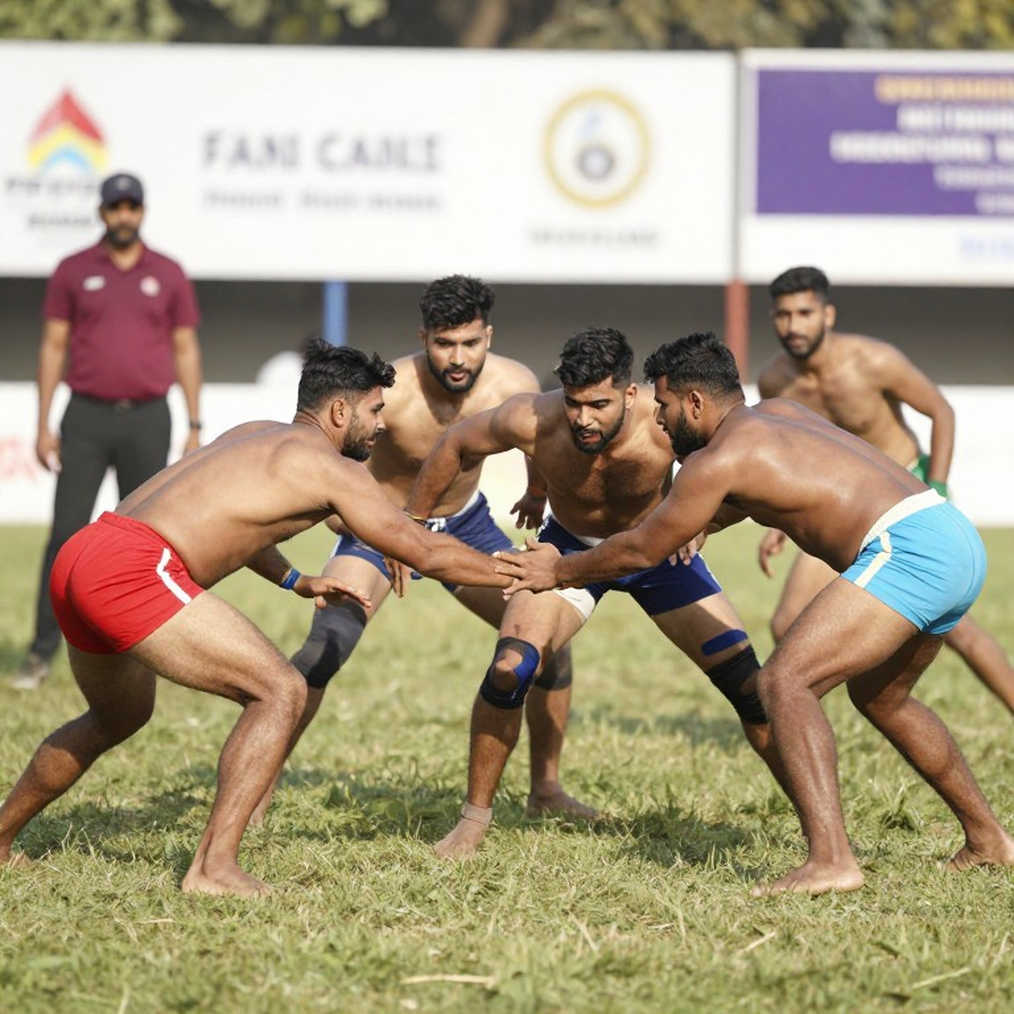
That adaptation gap is one of the least reported stories in diaspora kabaddi, and it plausibly explains the 89-point total in the Scotland-Australia match: unstructured defence on both sides, so raids kept working. One match and zero tackle statistics will not settle it. It is the direction worth watching over the next three days.
Two African wins: worth tracking, not a power shift
Kenya beat Singapore 48-28. Uganda beat Malaysia 45-29. Two comfortable African wins over Asian opposition on the same day. In the standard internationalisation narrative, African sides are cast as participants rather than competitors. Two wins is a small, genuine signal.
And this is where I have to rein in my oldest bias. After eleven years beside the mat, my first instinct still runs to "not ready yet" for teams outside Asia. Two wins do not break that instinct. The correct conclusion is that these sides deserve tracking — and if Kenya wins its second match by twenty again, the conversation changes.
India's 46-26 and one blank space
India beat England by twenty. By India's standards that is solid, not dominant — Sri Lanka's margin was +27, larger, on the same day. But no conclusion can be drawn from the scoreline because the decisive variable is missing: squad composition.
The report never says whether India fielded its senior national side or a development group. Without that, 46-26 means nothing. A senior side beating England by twenty is routine; a development side doing it is encouraging; a mixed side doing it is unreadable, because it measures neither ceiling nor preparation.
The absence of any Indian individual statistic suggests the report was assembled from a results or standings feed rather than from the mat. Thirty-five information points, zero attributed sources, zero quotes, zero tactical sentences. That silence is not evidence of conspiracy. It is evidence that whoever wrote it watched a scoresheet, not a match.
The bigger question: who does "Commonwealth" exclude
This tournament tells you less about kabaddi's global depth than about who is permitted to enter. Commonwealth membership is a filter, and it removes Iran — the sport's undisputed second power and the only nation to have broken India's Asian Games men's gold monopoly. India lost that Jakarta 2026 semifinal 18-27, and the defeat was not an accident.
Iran is not a Commonwealth member, so it is not in this bracket. South Korea is out too, a country that plays kabaddi institutionally. Thirteen teams are competing and the world's second-ranked side is absent, not because it played badly but because of its passport status.
Here I have to doubt my own copy. The easy move is to file Iran's absence as an Indian conspiracy and close the paragraph. The truth is that Iran's alibi is half true as well. Iran does not send second-string teams to B-tier events; its calendar is built around the Asian Games and the World Cup. The consequence is that Iran's bench is never tested, and when the generation of defenders like Fazel Atrachali steps away there will be no verified replacement. Sitting out a tournament is Iran's right; the cost of sitting out is also Iran's to pay, and it will show up in the next generation.
Look at Bangladesh the same way. Third in Group B badly understates it. A team that has not raided and sits third is third on paper — on the mat it may be the strongest side in the group. And because Scotland has already banked +29, beating Scotland will not be enough for Bangladesh; it will need to win big. That is where the score-difference rule turns sport into theatre, and the theatre opens on Day 2 when Bangladesh finally walks on.
The table is not preliminary, it is misleading
The report warns twice that the table can change. That is factually correct and analytically thin. The problem is not that it will change. The problem is that three teams sit mid-table purely because they have not played. A reader opening the paper sees Nigeria fourth and assumes Nigeria did something. Nigeria did nothing.
If one thing survives, let it be this: Day 1 here is close to worthless as prediction and highly informative as structure. Where margin earns points, strong teams do not show mercy to weak ones — which is why 59-30 and 48-21 appear, and why the competitive credibility of events like this is always in question. Scotland did nothing wrong. The rule let it happen.
One risk I cannot dismiss: the report never states whether this is Standard Style or Circle Style. Several entrants — Scotland, England, Canada, Australia — rest on a Punjabi diaspora whose domestic kabaddi is Circle Style. If the mat is Standard and the habit is Circle, a single refereeing call can become a dispute. The probability is low; omitting it would hide the most necessary warning from the reader.
What to watch next
Bangladesh's first raid. India's team sheet — senior or development, one line that would change the meaning of the whole event. Whether qualification rules get published anywhere. And whether a single tackle number appears. If none of those four arrive, we should accept that this event is running on its name rather than its results.
Eleven years have taught me that a title's worth is set by its entry rules, not its final. The honest question about Ahmedabad is not who wins. It is what a medal weighs when the world's second-best team was turned away at the door — and whether anyone will bother widening that door next year, or whether we will read another table with fourth place occupied by a side that never raided.